Step onto the captivating world of Hotrail Productions, where the magic of lights, camera, and trains combines to create an unforgettable experience. I travel all over the country photographing railroad history in the making. My footage dates back to 1995. Whether it's a thrilling action sequence or a heartwarming romantic scene, the railway has long been a favorite setting for filmmakers and TV producers.
On December 8, 2023, a grade crossing accident occurred in downtown Ocotlan, Mexico. A westbound Ferromex freight train was heading through the inadequately-protected grade crossing at Madero Street. While this photographer was filming the passing train a quarter of a mile away, the train suddenly went into emergency. After walking around the stopped train, it was discovered that an SUV had struck and shoved into the bushes! The paramedics arrived and transported the injured family to the hospital. Hopefully no one was seriously injured.
The railroad crossing lacked gates, bells, or flashers. This is a busy downtown area, with Mexican automobiles, bikers, cyclists, and pedestrians pouring across the tracks like water from a broken dam. Such a setup like this would be inconceivable in America.
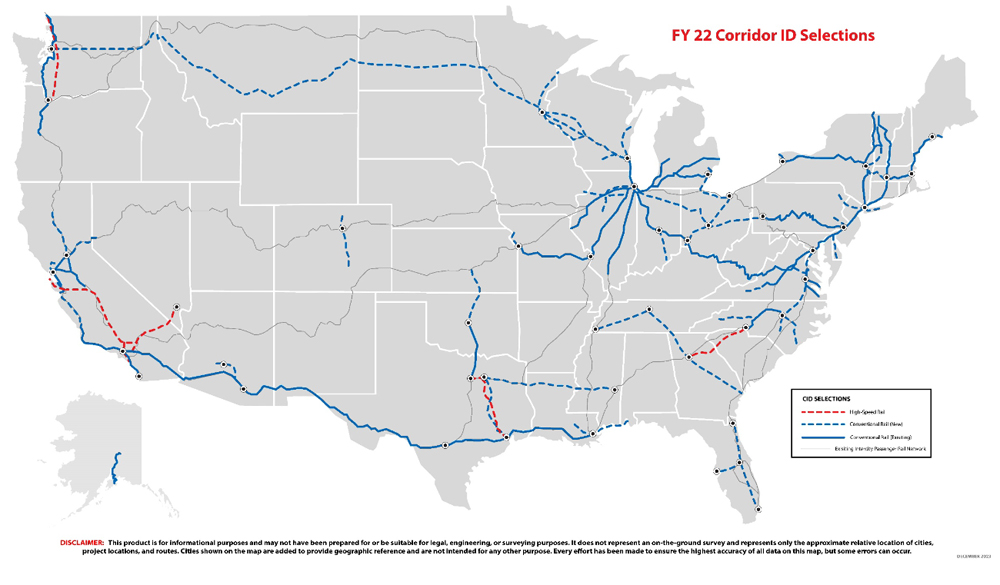
Thirty-four new routes among 69 selected, which also include high speed projects, those seeking to increase frequencies
The
routes selected for the Federal Railroad Administration Corridor Identification and Development Program. New routes are dotted blue
lines; existing routes seeking service increases are solid blue; high
speed routes are dotted red. FRA
WASHINGTON — The Federal Railroad Administration has released its list of routes selected
for the first step of its Corridor Identification and Development
Program, a catch-all group of 69 potential future Amtrak routes,
possible extensions to existing routes, efforts to increase service on
existing routes, and future high speed rail systems.
Thirty-three of these routes had previously been reported by Trains News Wire as they were announced by elected officials; in the lists below, they are indicated with italics.
The vast majority of routes are corridor services that will require
state support, but among the routes seeking increased service are
Amtrak’s two current triweekly long-distance trains, the New
York-Washington-Indianapolis-Chicago Cardinal and the Los Angeles-New Orleans Sunset Limited.
Selection is the first phase of a process that could take as much as
seven to 10 years before service begins on new routes, according to some
of those involved. It brings a $500,000 grant to be used to create a
Service Development Plan, which estimates the cost and timeline for
launching service, among other features. That grant goes to the
organization that applied for inclusion in the program, indicated in
parentheses on the lists below.
The selections were presented in four categories: new routes,
existing routes with extensions, existing routes, and high-speed rail.
FRA Administrator Amit Bose said in a statement
that the agency is “taking full advantage of the resources we have to
advance world-class passenger rail services nationwide. Today’s
announcement is another step forward as we advance transformative
projects that will carry Americans for decades to come and provide them
with convenient, climate-friendly alternatives to congested roads and
airports. We’re thinking about the future too with comprehensive and
systematic planning efforts to transform the U.S. intercity passenger
rail network now and in the years to come.”
New routes
A total of 34 new routes were selected; some are in advanced stages
of planning and others have essentially been previously unknown. They
are:
— Asheville-Salisbury, N.C. (North Carolina Department of Transportation)
— Atlanta-Savannah, Ga. (Georgia DOT)
— Atlanta-Chattanooga-Nashville-Memphis (City of Chattanooga)
— Baton Rouge-New Orleans (Louisiana Department of Transportation and Development)
The hodgepodge nature of the Corridor ID program is illustrated by
programs ranging from the nearly ready to run, such as the Gulf Coast
route, to those that seem rather hastily assembled, like the Delaware
proposal that has yet to define endpoints. The second train on the Empire Builder
route between Chicago and the Twin Cities is for some reason classified
as new service rather than fallling into the existing route categories
below.
Existing routes with extensions
A
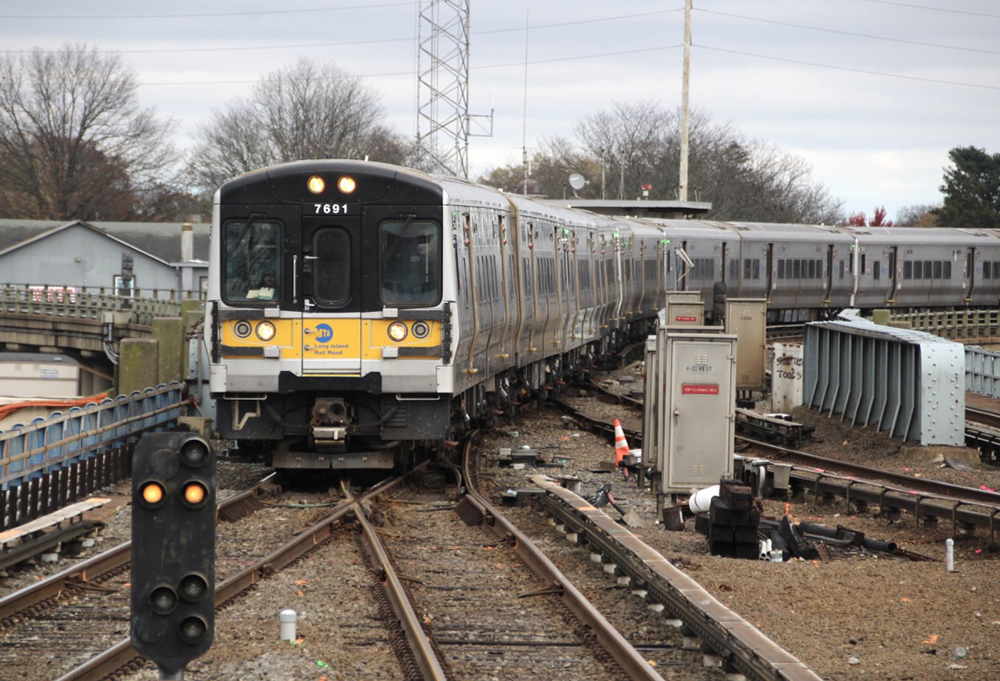
Long Island Rail Road train from the Ronkonkoma Branch navigatesDivide
interlocking as it arrives at Hicksville, N.Y., on Nov. 13, 2022.
Amtrak seeks to extend service to Ronkonkoma on the LIRR with stops in
Hicksville and Jamaica. David Lassen
Some 13 routes fall into this group:
— Amtrak to Long Island (Amtrak): A proposal to extend three existing
Northeast Regional round trips between Washington and New York to
Ronkonkoma, N.Y., on the Long Island Rail Road, with intermediate stops
at Jamaica and Hicksville.
— Capitol Corridor (Caltrans): Would add to the existing San
Jose-Auburn, Calif., corridor with extensions to San Francisco, Salinas,
and Novato, Calif., and Reno/Sparks, Nev.
— Downeaster Corridor (Northern New England Passenger Rail
Authority): Would extend the route to Rockland, Maine, add additional
frequencies, add an infill station at West Falmouth, Maine, and make
improvements to allow better connections in Boston, where the Downeaster uses a different station than all other Amtrak services.
— Green Mountain Corridor (Vermont Agency of Transportation): Would
connect New York and Burlington, Vt., via Albany, N.Y.,and Rutland, Vt.,
dovetailing with the Ethan Allen Express by providing new service to communities including Bennington and Manchester, Vt., and Mechanicville, N.Y.
— Extension of Chicago-Quincy corridor to Hannibal, Mo. (Missouri DOT): Would extend the route currently used by the Ilinois Zephyr/Carl Sandburg.
— Heartland Flyer extension (Kansas DOT): Would extend the current
Fort Worth-Oklahoma City train northward to Wichita and Newton, Kan.,
where it would connect with the Southwest Chief [see “Kansas DOT holds public meeting …,” Trains News Wire, Nov. 10, 2023].
— Kansas City, Mo.-St. Joseph, Mo. (Missouri DOT): Would provide a connection with the existing Missouri River Runner.
— San Luis Obispo-San Diego LOSSAN Rail Corridor (Caltrans): Proposes
a small extension — from its current southern endpoint of San Diego to
San Ysidro, Calif, about 16 miles — as well as additional frequencies
and improvements to reliability.
— Milwaukee-Green Bay Hiawatha extension (Wisconsin DOT): Would extend the existing Chicago-Miwaukee service.
— San Joaquin Valley Corridor (Caltrans): Would extend the existing
service north from Sacramento to Chico and Redding, Calif., while also
increasing frequencies.
— Vermonter Corridor (Vermont
Agency of Transportation): Would extend service north to Montreal, with
creation of a customs preclearance facility at Montreal’s Central
Station, add frequencies, and reduce travel time.
— Washington to Bristol, Va. Corridor (Virginia Department of Rail and Public Transportation): Would extend existing Northeast Regional service between Washington and Roanoke Va, to Bristol; add an infill station at Bedford, Va.,. and increase frequencies.
— Wolverine Corridor (Michigan DOT): Would extend service to Windsor,
Ontario, and include improvements to travel time and reliability.
Existing routes
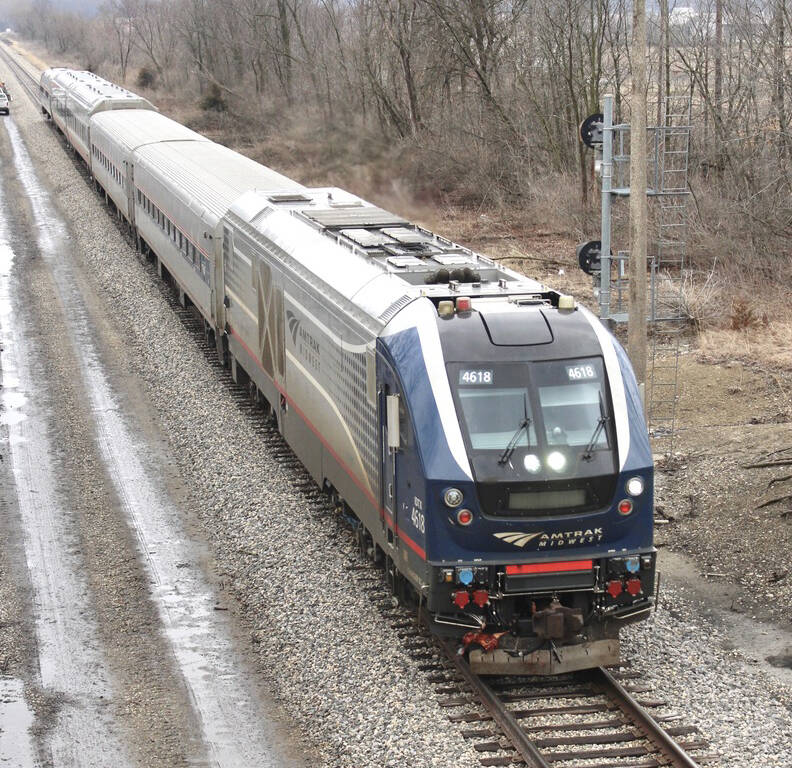
Wolverine
corridor train No. 353 approaches Three Oaks, Mich., on March 23, 2023. Michigan is seeking to increase or extend service on its corridorroutesincluding the Wolverine. Bob Johnston
These 15 routes — eight of them previously reported — seek additional
frequencies or other infrastructure improvements, with other details as
noted:
— Adirondack Corridor (New York State DOT): Seeks a custom preclearance facility in Montreal
— Amtrak Cascades Corridor (Washington State DOT)
— Anchorage North and South Corridor (Alaska Railroad Corp.)
— Charlotte-Washington Corridor (North Carolina DOT): Seeks
improvements including the Raleigh-to-Richmond project that received a
$1.1 billion Federal-State Partnership grant.
— Chicago-Carbondale Corridor (Illinois DOT)
— Chicago-Grand Rapids Corridor (Michigan DOT)
— Chicago-Port Huron Corridor (Michigan DOT)
— Chicago-St. Louis Higher-Speed Corridor (Illinois DOT)
— Daily Cardinal service (Amtrak)
— Daily Sunset Limited service (Amtrak): Like the Cardinal, would be increased from the current triweekly schedule.
— Empire Corridor (New York State DOT)
— Hartford Line Corridor (Connecticut DOT)
— Indianapolis-Chicago Corridor [Indiana DOT]: Could the Hoosier State live again? Indiana says it seeks new frequencies and improved travel times on this portion of the Cardinal route, and is undertaking this effort in connection with the daily Cardinal project.
— Keystone Corridor (Pennsylvania DOT): A selection tied to
the $143.6 million Federal-State Partnership grant for improvements
between Pittsburgh and Harrisburg.
— Milwaukee-Chicago Hiawatha Corridor (Wisconsin DOT):
Previous efforts to increase service were shot down by objections in
Glenview, Ill., to a siding that was part of an agreement between
Amtrak, Canadian Pacific, and the other parties involved.
High speed routes
While clearly projects of a
different nature than those above — both in orders of magnitude of
expense and timeline for development — high-speed projects have been
included in the Corridor ID program, presumably because selection is a
key to eligibility for other forms of federal funding. Only the
Charlotte-Atlanta project had previously been mentioned as part of the
Corridor ID program in announcements by legislators, although the
California and Brightline West projects received major federal funding
in the Federal-State Partnership program.
— Dallas-Houston (Amtrak)
— Fort Worth-Houston (North Central Texas Council of Governments)
— Brightline West (Nevada DOT)
— California High-Speed Rail phase 1 (California High-Speed Rail Authority)
— Cascadia corridor — Vancouver, British Columbia-Portland, Ore. (Washington State DOT)
— Charlotte, N.C.-Atlanta, Ga. (North Carolina DOT)
— High Desert Corridor — Victor Valley-Palmdale, Calif. (Antelope Valley Transit Authority)
Notably, there are competing Texas high speed projects. Amtrak has
joined with the Texas Central project, while the North Central Texas
group would include both Dallas and Fort Worth; the latter was left out
of the Texas Central plan. Like the other projects, these receive
$500,000 grants, which likely won’t go very far for high speed planning.
Step onto the captivating world of Hotrail Productions, where the magic of lights, camera, and trains combines to create an unforgettable experience. Whether it's a thrilling action sequence or a heartwarming romantic scene, the railway has long been a favorite setting for filmmakers and TV producers. From historic steam locomotives to sleek high-speed trains, rail productions offer a diverse range of possibilities for filmmakers. The rumbling of wheels on the tracks, the expansive landscapes passing by, and the undeniable charm of train travel all contribute to the allure of these productions. We'll also uncover the techniques used to capture the dynamic beauty of trains on camera, from tracking shots to aerial footage. Get ready to be swept away by the sights and sounds of this extraordinary behind-the-scenes realm.
A Mexico trip is in the making. While my Mexico travel visa is being processed, I have witnessed railroading in a world far different than the West. Mexico travel from the US is tiring, yet interesting. Laws in Mexico are more lax when it comes to traffic, and you need to be an aggressive driver! Mexican law enforcement has shut down local roadways after shootings in order to lock in the suspects. Roadside checks are frequent for immigration and drug searches To see a person in law enforcement uniform riding a freight train is most unusual, but it essential here to catch any illegal migrants or cartels moving their cargo.
The railroad junction at Logansport, Indiana has been very underrated
in recent years. Both Norfolk Southern and Genesee & Wyoming
provide plenty of interesting movements. The G&W operates the former
PRR Panhandle Line from Kenneth to Kokomo. Norfolk Southern operates
the former Wabash Railroad that crosses the Wabash river and swings
through a hairpin turn to cross the G&W diamond. Located on a
riverbend on the Wabash River, this junction is known as Elm Street
Interlocking. A river island, known as Biddle Island, lies in the middle
of the river, and provides unique photo opportunities.
Here
a long eastbound Norfolk Southern freight train is running with three
locomotives operating "elephant style." This means that all the locos
are facing forward. This origin of this railroad term derides from
elephants holding the tail of the elephant in front of them as they walk
in a row.
New 15-mile base tunnel includes dual-gauge trackage
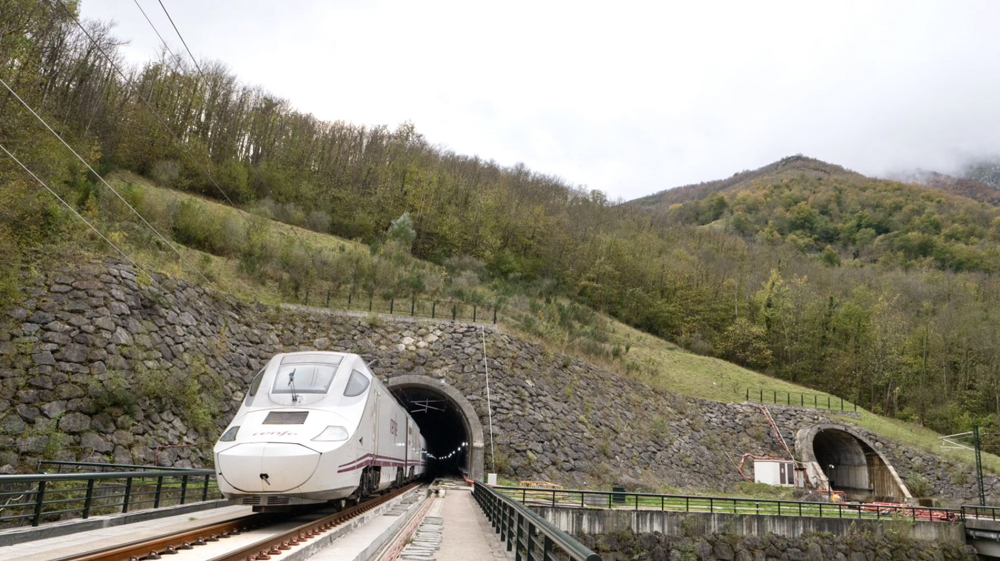
A
RENFE Class 130 Alvia’ train exits the Pajares Base Tunnel. This type
of train will be used for passenger service; it can change gauge and
voltage, overcoming the new line’s operating complexities. Courtesy ADIF
AV
MADRID — The King of Spain, King Felipe VI, and his top government
ministers have officially opened a new railway line linking the northern
province of Asturias to the rest of the Spanish high-speed network,
traveling on Nov. 29 in a specially operated high speed train between
Madrid and Gijon on the northern coast of Asturias. Regular passenger
services began the next day, Thursday, Nov. 30.
The 31.25-mile-long new section of railway includes the 15.43-mile
Pajares Base Tunnel, now Europe’s seventh-longest rail tunnel, built
underneath the Cantabrian mountain range. The new line shortens the
distance by rail between the cities of Oviedo and León by 23 miles,
avoiding the old steeply graded and circuitous line over the Pajares
Pass.
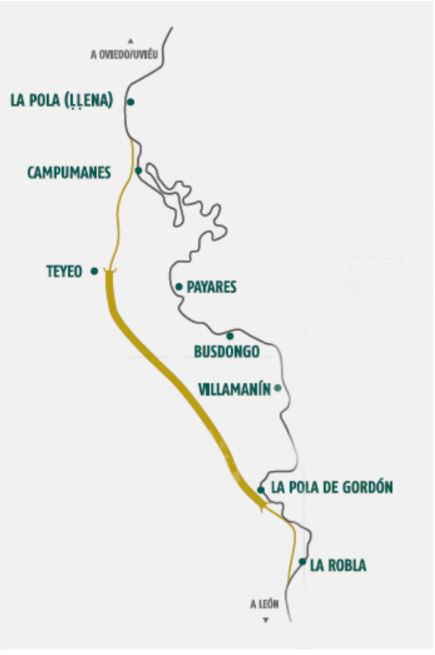
The
new line including the Pajares Base Tunnel is shown in gold, while the
old Parajes Pass line is in gray at right. Courtesy ADIF AV
In addition to the 275-kilometer-per-hour (172-mph) base tunnel, the
new 200km/h (125-mph) line features 10 more tunnels and 10 viaducts. It
reduces travel times for both passenger and freight trains by more than
an hour.
Construction of the twin-bore base tunnel took 20 years beginning in
2004, and involved five tunnel boring machines working simultaneously —
four for the rail tunnels and one for a 4-mile emergency access tunnel.
Complex geology and high levels of water ingress from multiple aquifers
delayed progress multiple times, and on several occasions, project
opponents suggested it be shelved. The tunnel is built as a gradual
slope downwards heading north, as the land in central Spain is higher
than on the other side of the mountains in Asturias.
While base tunnels are not unusual in Europe — there are several in
Switzerland and more under construction in Austria, Italy, and France —
the railway in the Pajares Base tunnel is unusually complex. This is due
to designers trying to accommodate all the trains that used the old
line through the mountains (which will likely be abandoned at some
point) as well as the new high speed services. To do this, tracks of
both Iberian broad gauge (1,668mm/5 feet, 521⁄32 inches)
and standard gauge have been laid. In one of the two running tunnels
both gauges have been installed, while the westernmost bore is broad
gauge only — but features special concrete ties, used widely in Spain,
that allow for installation of another rail to create a dual-gauge line
in the future.
To add even more complexity, the new tunnels use the 25kV AC
electrification standard for Spain’s high speed network — but the broad
gauge trains will all be freight, and there are almost no freight
locomotives in Spain that can switch to that power system from the 3kV
DC used everywhere else on the broad gauge network. In fact, there are
currently just 18 such locomotives, all built in the last year or two by
Stadler in Spain and used by two freight companies: RENFE, the
state-owned railway, and Captrain, owned by French state railway SNCF.
A gauge changer for high speed trains has been built at the north end
of the base tunnel to enable special gauge-changing high speed trains
to switch to the broad gauge for the remainder of their journey north
into Asturias.
The new line cost around $4.4 billion, according to Spanish national
rail infrastructure manager ADIF, with substantial funds from the
European Union. This isn’t the last high speed line to open in Spain;
multiple sections of new routes are currently being built around the
country so that by the 2030s, almost every major city will join the
network.
High speed competition growing
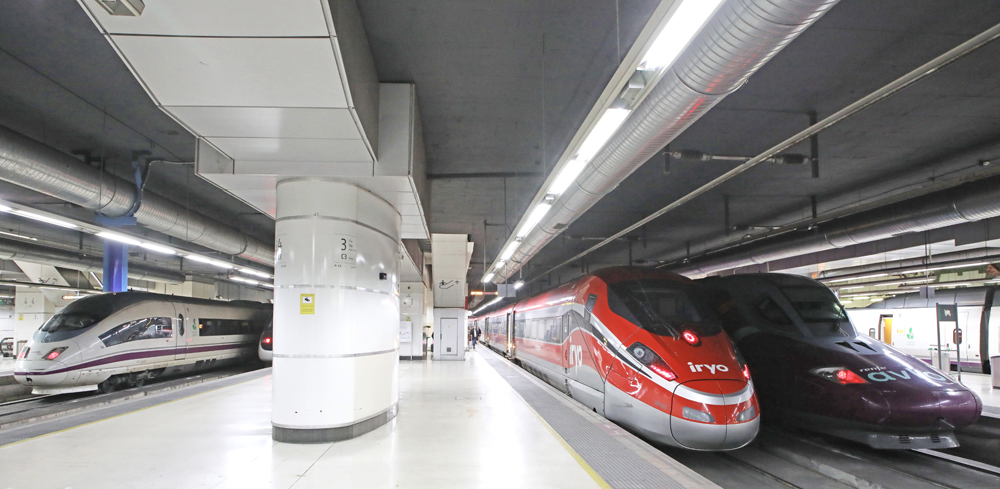
Competing
high speed trains share platform space in Barcelona in January 2023 . On the right, in red, is an Iryo Class 109 EMU 109 003 and a purple
RENFE “low cost” Avlo Class 112 train. On the left is a RENFE Velaro AVE
high speed EMU. Keith Fender
Since late 2022, Spain is the only nation with three competing high
speed rail operators on the same tracks and routes. One of them, state
rail company RENFE, has two completely differently branded operations —
so for most passengers, it seems like there are four operators.
This competition hasn’t happened by accident. Infrastructure company
ADIF, which has spent billions building the high speed rail network
since the 1990s, set out to attract more business. Competing trains
using its tracks have been good for ADIF’s finances, as every operator
has to pay to use the infrastructure, which not only covers the
maintenance costs, but in the long term will pay off the cost of
building the lines as well. ADIF has been quite prescriptive in
tendering slots, insisting on frequent services and on multiple routes,
so any operator starting out has to run a full service, not just at busy
times when peak fares can be charged. The companies run the services at
their own risk, as they are not subsidized.
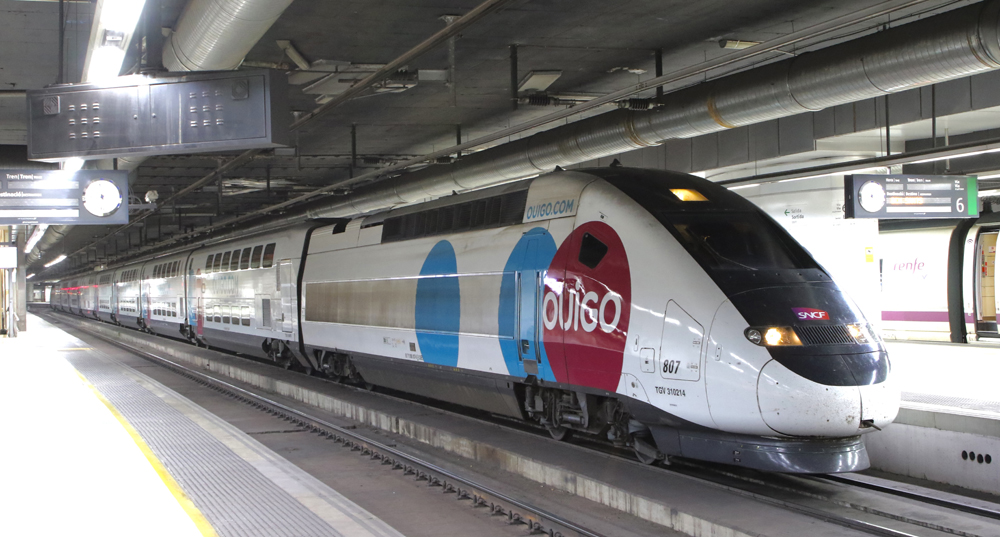
SNCF’s
Ouigo España set 807 seen at Barcelona Sants on Nov. 6, 2021, a few
months after the operation began. The train had arrived from Madrid.
Keith Fender
The first new entrant was France’s SNCF, which set up a subsidiary in
Spain and moved a small fleet of double-deck TGV trains there.
Operating initially between Madrid and Barcelona as of May 2021, these
use the “OuiGo” low-cost branding SNCF also uses in France. OuiGo España
operations have since expanded to include Madrid-Valencia in 2022 and
Madrid-Alicante since April of this year.
The next new high speed operator — branded as “Iryo” — is owned by
Intermodalidad de Levante S.A. (ILSA), a three-way, jointly owned
company in which Italian state rail operator Trenitalia is the largest
shareholder with 45%. Other partners are Spanish airline Air Nostrum
(31%) and global infrastructure/transport investor Globalvia (24%). Iryo
began operating in November 2022 with 12 train pairs each day on the
Madrid-Zaragoza-Barcelona route. Iryo is using 20 brand-new,
high-specification Frecciarossa 1000 trains built by Hitachi in Italy —
these trains are basically the same type Trenitalia uses in Italy and
France. Iryo offers a range of service from economy to all-inclusive
business class, and onboard catering is available for all passengers.
Iryo expanded its operation to include the Madrid-Valencia route in
December 2022 and added services from Madrid to Córdoba, Sevilla, and
Málaga in March this year.
RENFE has reacted to the on-track
competition from Iryo and low-cost OuiGo by operating more of its own
“low cost” Avlo services, as well as its regular “AVE” services on the
same routes. Avlo services began on the Madrid-Barcelona-Figueres route
in June 2021, having been delayed by the COVID-19 pandemic. In February
2022, six Avlo train pairs a day began operation between Madrid and
Valencia, with Madrid-Alicante service starting in March 2023 and
between Madrid, Seville and Málaga in June.
For track owner ADIF, the competition is paying off. Revenues from
track access fees were up 44% in 2022, generating profits of around $200
million. By early 2023, around 1,000 high speed trains were operating
each day in Spain — a big jump from 2021, when the number was around
780. ADIF plans to open up more routes, especially those north of
Madrid, to more competition. However, some of these routes — e.g. the
new line through the Pajares Base Tunnel — require trains that can
change gauge, and only RENFE currently owns any of those.