Step onto the captivating world of Hotrail Productions, where the magic of lights, camera, and trains combines to create an unforgettable experience. I travel all over the country photographing railroad history in the making. My footage dates back to 1995. Whether it's a thrilling action sequence or a heartwarming romantic scene, the railway has long been a favorite setting for filmmakers and TV producers.
Two Canadian National freight trains meet at the Lake Villa Metra station. The first train is led by a rare EMD SD75I and a GE ES44DC. The second train is led by an EMD SD70 still in Illinois Central paint and an EMD SD70M-2.
This pair of NYC Tri-Light signals guarded the NS EX-NYC Water Level Route at Brimfield, Indiana. Note that the signal bridge only has one light. These were replaced in 2018.
Union Pacific–Norfolk Southern merger and Chicago rail
01.12.2025
The
Union Pacific–Norfolk Southern merger is being sold as a cure for one
of the most stubborn knots in the U.S. freight system: Chicago rail
congestion.
This is reported by the railway transport news portal Railway Supply.
Photo: E. Jason Wambsgans/Chicago Tribune
Through
an $85 billion acquisition of Norfolk Southern, Union Pacific wants to
knit together a single coast-to-coast railroad that would carry nearly
half of all U.S. rail freight and, in its view, ease a long-standing
bottleneck in and around the Chicago hub.
Political pushback and shipping costs
Whether
this actually solves Chicago rail congestion and bottlenecks is very
much up for debate. A range of shippers and public officials has already
voiced concern, as noted by Railway Supply.
In a letter sent last month, nine Republican attorneys general warned
that the merged carrier’s “increased monopolistic power” could push
shipping costs higher and weaken the United States’ competitive position
in global trade.
For
ordinary Chicago residents, those shipping costs are already tangible.
Capital One’s retail data show that in 2024 Americans received an
average of 66 packages—up 78% over seven years—while the average price
per package slipped a mere 4%. Union Pacific argues that, over time, the
merger and the new coast-to-coast railroad would boost efficiency,
remove trucks from highways, and cut both congestion and pollution on
Chicago-area roads and on the northeast Illinois rail network that today
carries 1 in 4 U.S. freight trains.
Neighborhood impacts and Surface Transportation Board review
Life
looks different along the tracks. Neighborhoods clustered around rail
lines and terminals where the combined railroad might expand could see
longer waits at crossings, more train noise and added environmental
strain. That is the concern raised by Earl Wacker, a former CSX
executive and now a transportation consultant with RINA North America in
Chicago.
“The
influx of freight trains through Chicago has the potential to cause
substantial delays in local commuters’ schedules and inconvenience their
daily lives,” Wacker wrote in Railway Age magazine, bringing the national debate down to the level of daily routines.
Union
Pacific intends to submit a detailed merger application to the federal
Surface Transportation Board (STB) as soon as this week, spokesperson
Kristen South said. The companies have already set out their case for
the transaction and for the STB process in a joint press release from Union Pacific and Norfolk Southern, and the formal filing itself is expected to run to thousands of pages.
Once
lodged, the application will trigger an 18-month Surface Transportation
Board merger review and likely open the door to negotiations between
Union Pacific and affected communities and industries, including
chemical producers and agricultural shippers.
Depending on how
those talks unfold, the board could attach conditions to approval of the
Union Pacific–Norfolk Southern merger—restricting route changes or
price increases, capping the number of trains the combined company can
operate or setting limits on train length. In other words, the Surface
Transportation Board review of the rail merger will determine how far
the promised efficiencies can go and under what guardrails.
Chicago’s role as a freight hub
The
merger proposal lands on top of growth plans that were already in
motion. According to data released last year by the Association of
American Railroads, carriers were planning to increase rail capacity in
the Chicago region by nearly 80% by 2052. The area already has more
track mileage than 40 U.S. states, underlining its role as the country’s
primary rail crossroads.
That status has deep roots. Beginning in
1848, railroads raced to turn Chicago into the main commercial and
financial gateway connecting factories on the East Coast with emerging
markets and natural resources in the West. Instead of building
continuous transcontinental lines that ran straight through, they
generally found it cheaper and easier to bring freight into the city and
hand it off to another railroad there.
The
same pattern still shapes freight flows. In some yards, including one
near McKinley Park about 4 miles southwest of downtown, Union Pacific
and Norfolk Southern swap blocks of railcars. Elsewhere in the metro
area, the two carriers and other railroads exchange individual shipping
containers, reinforcing Chicago’s twin role as a crucial freight hub and
a notorious choke point.
Rubber-tire moves and coast-to-coast flows
Union
Pacific says a unified transcontinental network would change how
freight moves through that hub. Today, 40-foot international containers
typically spend about a week traveling from Los Angeles to Chicago and
then onward to destinations such as the western suburbs of New York
City. The railroad contends that a single through route created by the
merger could trim one or two days off that trip.
In the envisioned
network, containers would stay on trains operated by one carrier and
pass through the Chicago area without being unloaded. At present, many
containers are taken off trains in the city, trucked across town and
then reloaded onto a different railroad’s trains heading east. Those
crosstown truck transfers are known in the industry as “rubber-tire
moves.”
Union Pacific argues that a unified Chicago freight rail
network could remove hundreds of rubber-tire moves a day in and around
Chicago and hundreds more on routes linking Chicago with other Midwest
hubs such as Detroit; Columbus, Ohio; and Louisville, Kentucky. The
company says this would cut congestion and emissions and help rail win
back freight market share from long-haul trucks.
CEO Jim Vena has
been explicit about how confident he is. He told reporters this month
that he is “99.999% sure” the STB will eventually approve the merger. He
is effectively buying Norfolk Southern and maintains that this is the
only realistic way for railroads to pull traffic back from
diesel-powered trucking.
“A single coast-to-coast network will
deliver faster, more competitive service by eliminating car touches and
interchange delays, opening new routes, expanding intermodal services,
and ensuring faster transit times,” Vena wrote in a July letter to
employees. In the same letter, he pledged that the railroad “will take
even more trucks off highways.”
Bypass routes and Midwest freight rail jobs
Despite
these promises for the coast-to-coast railroad, intermodal container
trains have been losing ground. Larry Gross, an independent analyst
based in Denver, notes that in the third quarter container trains
accounted for only 10.9% of truck-size freight shipments longer than 500
miles in the U.S., down from 12.5% in 2018, with the rest of that
traffic moving by truck. Vena has also told Trains magazine that he
expects Chicago to remain “the nation’s premier rail crossroads,” and
that he does not foresee a wholesale shift of traffic away from Chicago
to Kansas City.
Yet railroaders have been complaining about
congestion in the Chicago region and threatening to bypass the city for a
century. As part of the merger, Union Pacific would pick up a Norfolk
Southern line that runs east from Kansas City through Springfield,
Illinois, and then northeast toward Fort Wayne, Indiana. On paper, that
alignment could serve as a Kansas City–Fort Wayne bypass route for some
traffic from southwestern gateways such as El Paso, Texas, allowing
certain intermodal trains to skirt Chicago altogether.
The idea is
complicated by a practical constraint flagged by Trains magazine editor
Bill Stephens: to make that bypass work, Union Pacific would need to
use a short section of track in Kansas City owned by its main rival,
BNSF Railway. Even a very large merger cannot avoid the realities of the
existing national rail map.
Meanwhile, the stakes for the
Chicago-area economy are substantial. The rail infrastructure that was
originally nurtured in Abraham Lincoln’s time still supports a large
share of local employment. Businesses that depend on frequent freight
shipments—manufacturing, construction, and wholesale and retail
trade—account for roughly a quarter of all jobs in the region, according
to the Chicago Metropolitan Agency for Planning.
If, over the
next decade or so, rail facilities in other Midwest towns grow at
Chicago’s expense, the pattern of freight rail jobs and the broader
Midwest logistics economy could shift. Independent railroad analyst
Anthony Hatch, based in New York, warns that such a realignment could
mean fewer warehouse and logistics jobs, fewer positions at parts
suppliers and fewer ancillary roles tied to the railroad.
“And
then the question is: Are those the kind of jobs you wish to retain
anyway?” Hatch said, framing the Union Pacific–Norfolk Southern merger
as a debate not only about network design and shipping costs, but also
about the future make-up of Chicago’s freight-related economy.
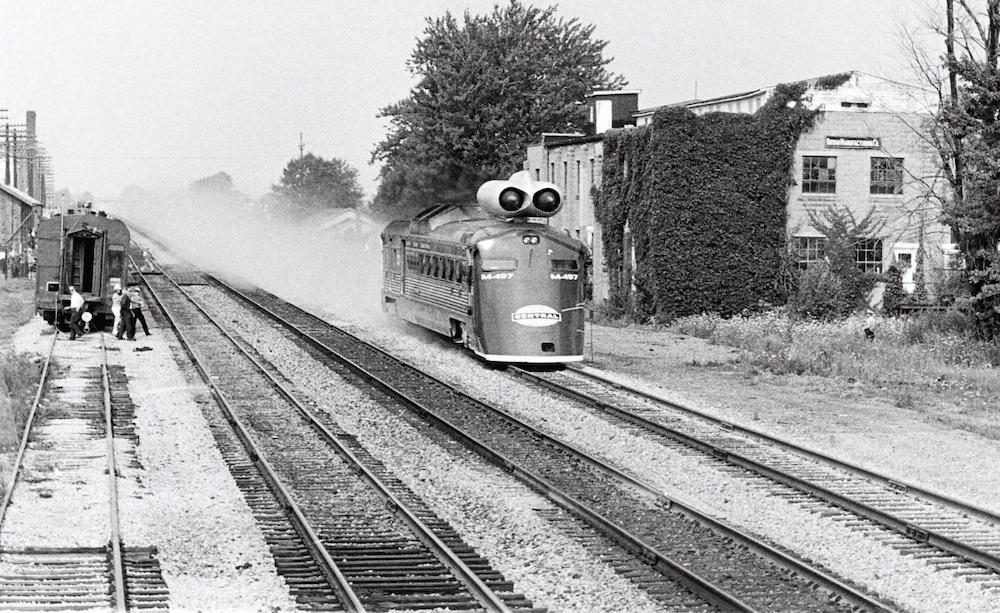
In July, 1966, The New York Central Railroad ran a modified RDC (Rail Diesel Car), over their mainline between Bryan, Ohio and Butler, Indiana. Equipped with jet engines, and a sloped front shield, the RDC reached 183 Miles per hour! High-Speed Rail had just been launched in Japan two years earlier, and hopes were that this experiment would pave the way for this type of travel in the United States. To this day, this record still stands as the highest speed obtained by a rail vehicle in the country. A beside the Amtrak station in Bryan, commemorates this event.
New York Central’s jet-powered ex Pride of the New York Central/
RDC kicks up dust and pelts onlookers with flying ballast on its way to
a 183.85-mph railroad speed record in July 1966. The General Electric
J-47 jet engines accelerated the 139,000-pound car from a standing start
to peak speed in four minutes. The standard Budd disc brakes needed
only a mile to stop the railcar. New York Central
On July 23, 1966, New York Central set a new U.S. railroad speed record when jet-powered RDC M-497, dubbed the Pride of the New York Central,
hit 183.85 mph on a 24-mile tangent section of 26-year-old joined rail
between Butler, Ind. and Stryker, Ohio. The RDC sported cylindrical
wheels in place of normal tapered-tread wheels, skirting, an additional
set of shock absorbers, and a sloped nose with F-unit number boards for
windshields. The modifications reportedly cost just $35,000.
The Central said the jet RDC was a scientific experiment to determine
the capabilities of standard equipment to run at ultra-high speed. But
some observers darkly suggested that it was an attempt to generate good
publicity even as the railroad was plotting to murder its passenger
trains – this same year, 1966, the NYC would seek permission to end its
legendary 20th Century Limited.
Whatever the reason, the jet RDC was a fascinating mix of old and new technology and bold innovation.
A westbound Canadian National train passes through Wellsboro. The lead unit is an EMD SD40-2 still in Illinois Central black with a P5 horn! A CN GE C44-9W follows.
Filmed in 2011.


 • Canadian National Railroad