Step onto the captivating world of Hotrail Productions, where the magic of lights, camera, and trains combines to create an unforgettable experience. I travel all over the country photographing railroad history in the making. My footage dates back to 1995. Whether it's a thrilling action sequence or a heartwarming romantic scene, the railway has long been a favorite setting for filmmakers and TV producers.
Additional power will help bolster the newest Class I's roster
Less
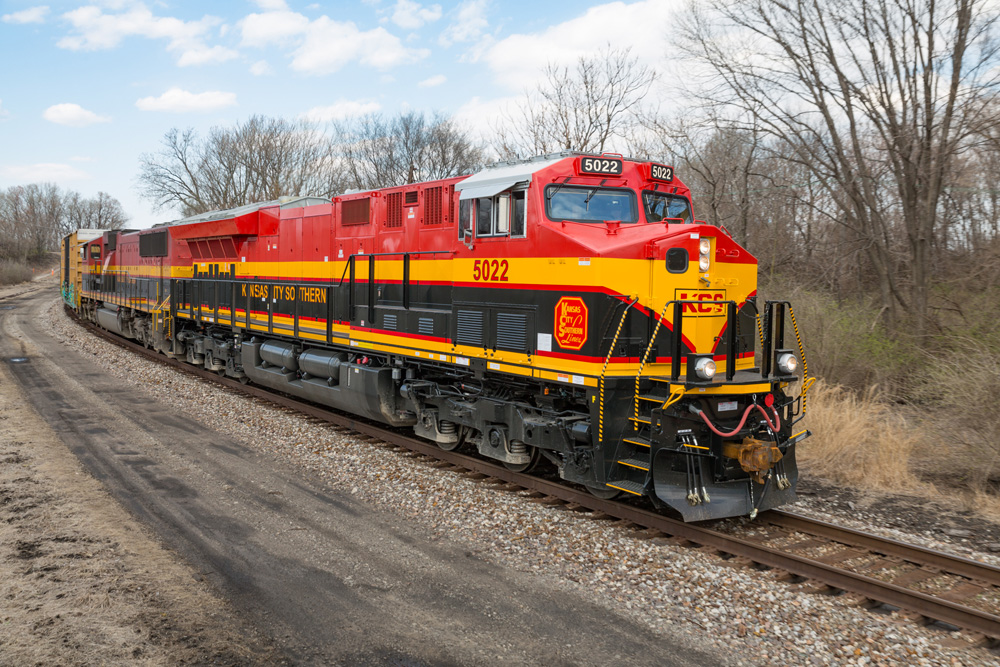
than 1-month old, new KCS ET44AC No. 5022 leads a train into East St.
Louis, Ill., on April 2, 2019. The new CPKC ET44AC order beginning
delivery in 2025 will increase the number of ET44ACs on the roster to
203 units. Chris Guss
CPKC will receive some much-needed motive power help starting next year in the form of a 170-unit order of new locomotives from Wabtec.
The railroad has been heavily
spending on capacity work across its combined system to support new
traffic and motive power has been in short supply to move tonnage across
its network. The order consists of 170 ET44ACs with delivery expected
to be spread across a number of years considering the large amount of
rebuild orders Wabtec already has committed to. Road numbers and
reporting marks for the new power hasn’t been disclosed yet.
The ET44ACs will join an existing
fleet of 33 ET44ACs, eight of which have recently joined the roster.
These eight were a canceled Baffinland Iron Mines order in Canada
that were selected from General Electric’s field test units. The other
25 ET44ACs were purchased new before the merger by Kansas City Southern
in 2019. The 25 former Kansas City Southern units are the most reliable
power on CPKC’s roster and are performing very well.
Prior
to the merger in 2023, Canadian Pacific had been the lone holdout
across Class I railroads in adding Tier 4-compliant locomotives, not
purchasing new units for over a decade before the CPKC merger. It
instead opted to rebuild existing GE and EMD AC traction locomotives,
the latter of which were long stored on the railroad. Canadian Pacific’s
SD9043MAC fleet was rebuilt to SD70ACUs in 2019 and 2020, adding 60
additional units to Canadian Pacific’s active roster. Canadian Pacific’s
last new power purchase was in 2012 when it bought 30 ES44ACs from
General Electric.
Media gets chance to tour Cascades trainset currently testing in Northeast
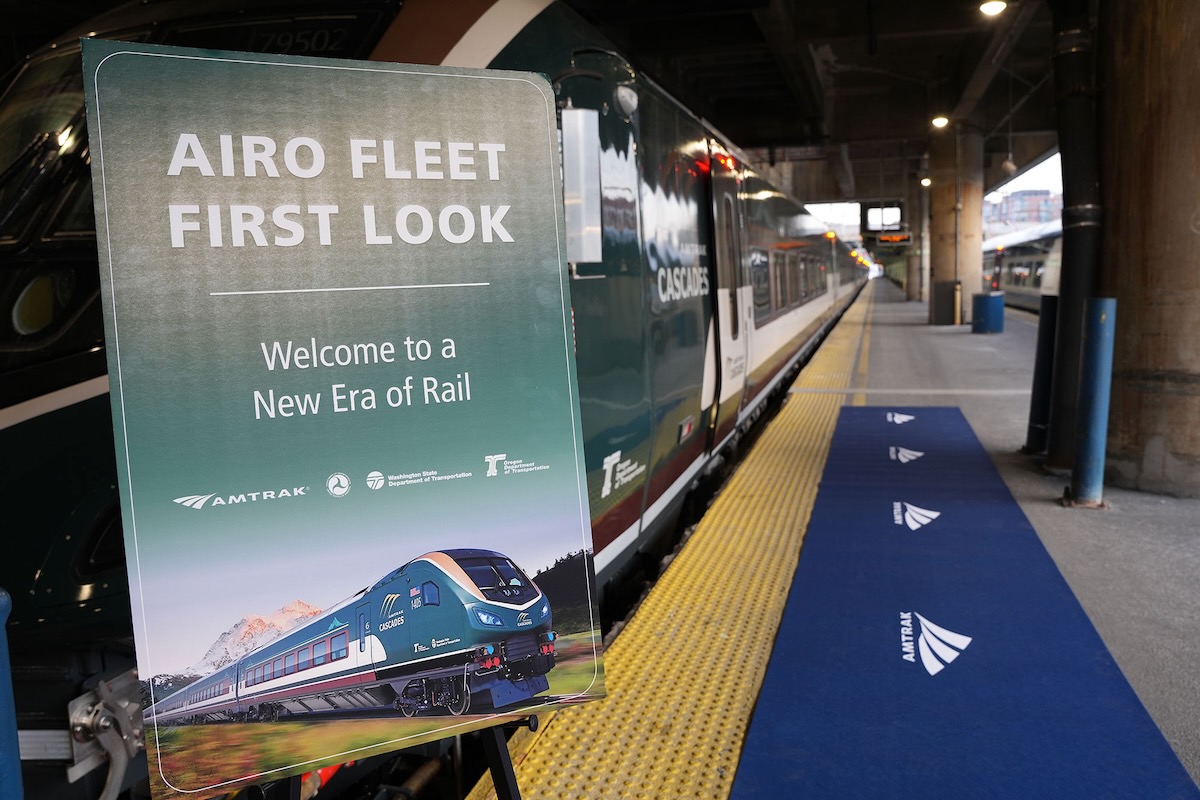
Amtrak unveiled its Airo equipment at a Feb. 10, 2026, event at Washington Union Station. Amtrak
WASHINGTON — Amtrak unveiled Airo, its newest fleet addition,
on
Tuesday with a media tour that featured an in-depth look at the interior
of the shiny,
feature-filled trainset that’s slated to begin revenue
service this summer on the Amtrak Cascades’
service in the Pacific Northwest.
Before offering a tour of coach, café car, and business class
equipment, speakers from Amtrak, manufacturer Siemens, and the
Department of Transportation extolled the virtues of the program
slated
to produce 83 trainsets for service on routes less than 750 miles long.
The Airo equipment is intended for 14 routes in the East, as well as the
Cascades that run between Eugene, Ore., and
Vancouver, British Columbia.
Amtrak President Roger Harris called the trainset parked at Union
Station —
wearing the green, brown, and white paint scheme unique to the
Cascades —
“the next step in Amtrak’s transformation,” following the introduction of NextGen Acela less
than five months ago.
“We can all be proud,” said Tobias Bauer, CEO of Siemens North America. “The train is beautiful.”
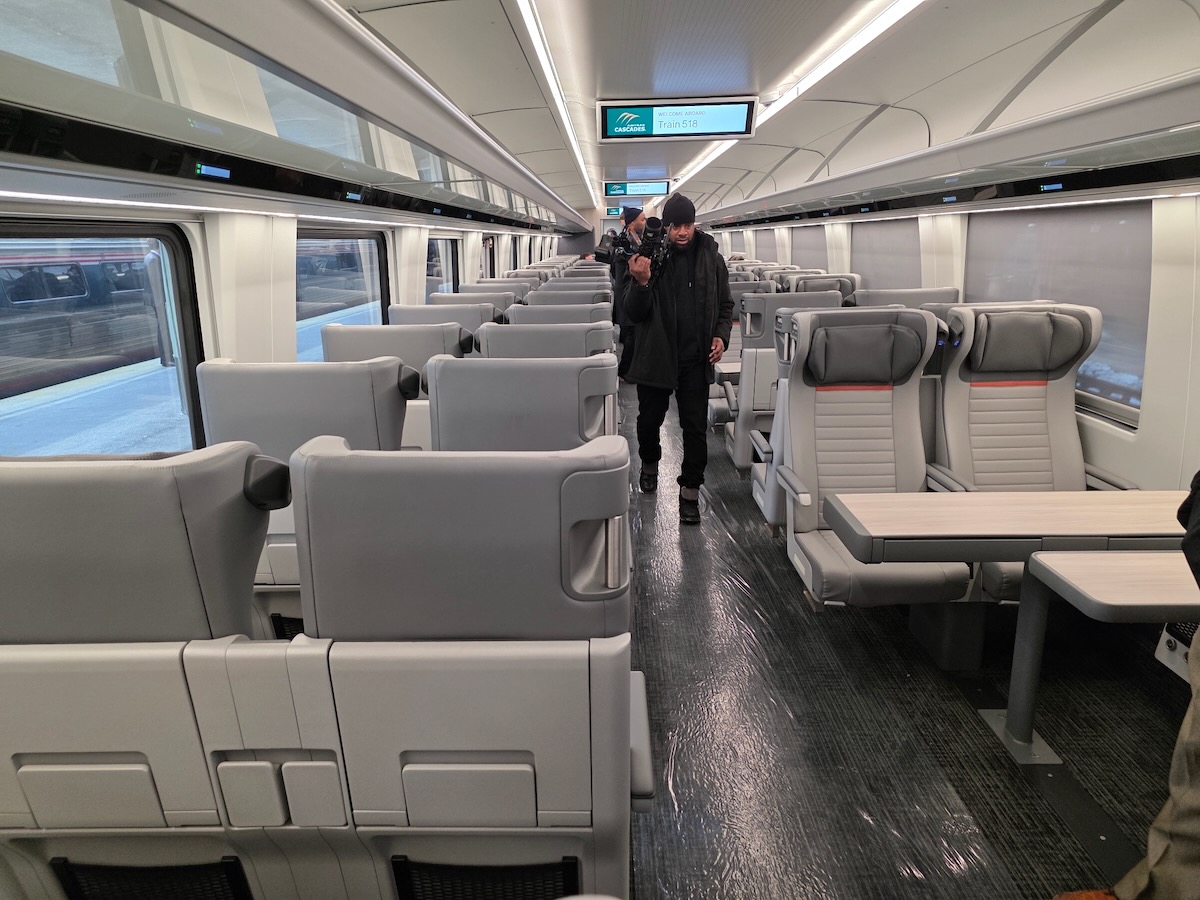
The interior of a coach-class car on the new Airo trainset. Rip Watson
Amtrak
literature describes Airo
as an “elevated experience” with “spacious
seating” and improved signage. For a reporter,
the tour showed off
bright and carefully designed seating, signage, and amenities intended
as upgrades from Amtrak’s workhorse Amfleet railcars.
There are three different types of Airo consist: seven-car trainsets
with 317-seat and 335-seat configurations, and a nine-car version
seating 479. The 317-seat arrangement includes a baggage compartment.
Cascades service will continue to offer checked baggage, said Michael
Carter, senior director of the Airo program.
In general, the train offers larger windows and seating meant to
improve on Amfleet design
shortcomings, including one that put too many
seats in places where riders had difficulty
looking out the windows. The
gray, ribbed seats feel much like Amfleet, based on a brief
test that
doesn’t offer a clue how they would feel on a long trip. Seat pitch is
37 inches in
coach and 39 inches in business class.
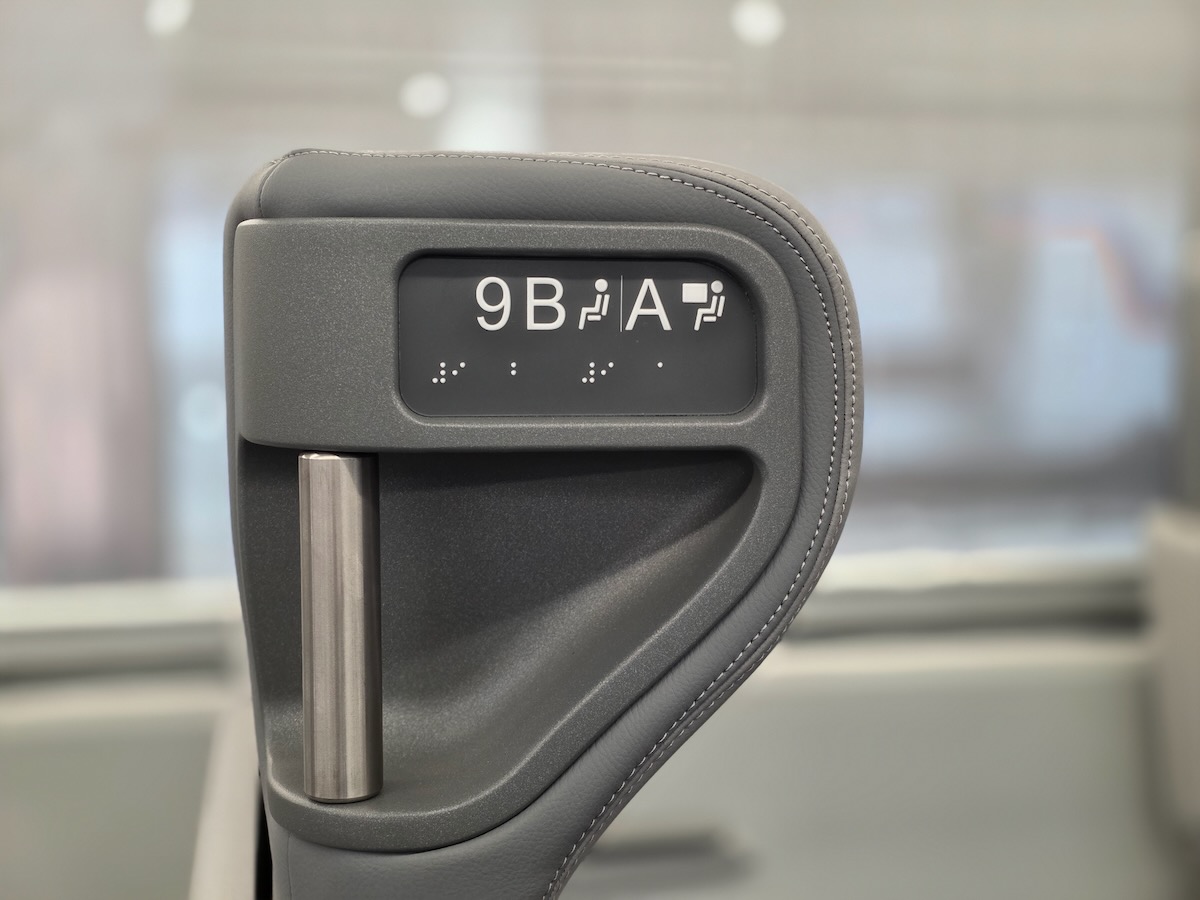
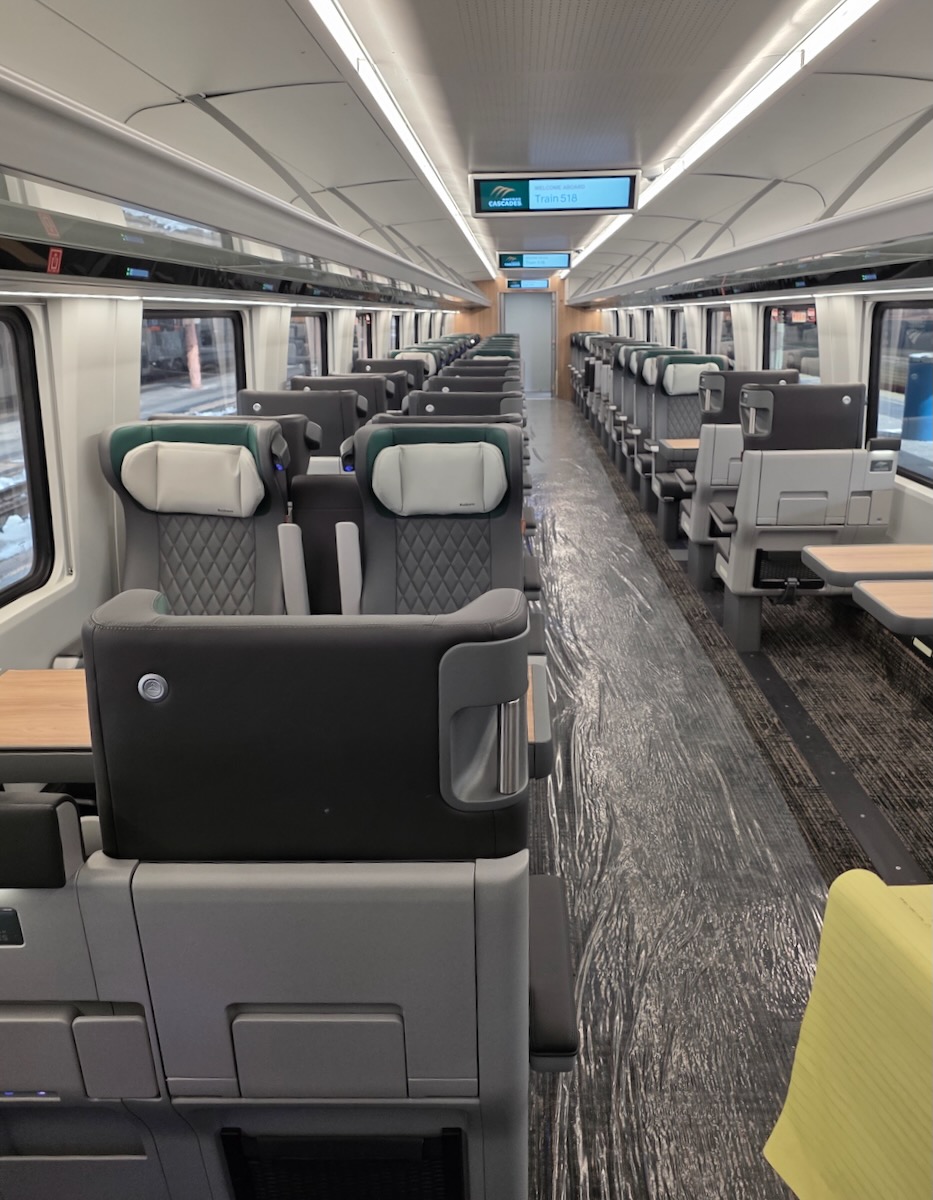
A safety feature of the Airo seats is a grab handle in each headrest along the aisles. Rip Watson
Half of the coach seats face forward. The others face backward. There are four tables in each coach car.
Among changes from Amfleet: 3 inches of extra space between
neighboring coach seats, reflecting customer research that showed more
space was a popular feature that Amfleet doesn’t offer. While Amfleet
cars have footrests (and Amfleet II features leg rests), coach seats in
the new trains seats do not have footrests, although business class
seats retain them.
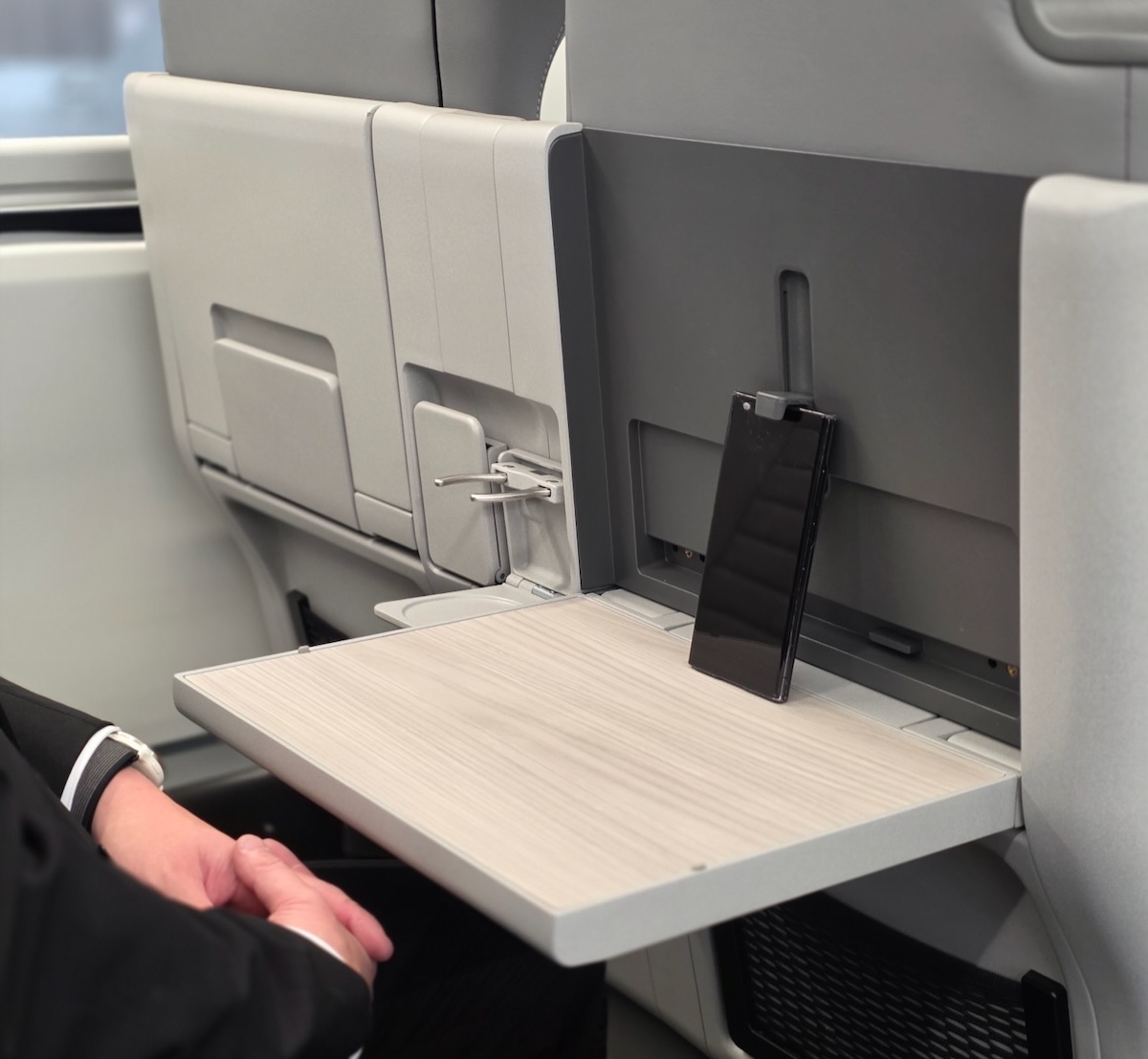
The drop-down seatback tables have space for a 15-inch laptop, as
well as a slot to hold phones or tablets. Plugs are located under each
seat. Each aisle seat has a grab bar for safety, said Amtrak Principal
Electrical Engineer Kevin Choi. Each seat has a reading light as well,
plugs for multiple devices, and a USB-C outlet, Choi said.
Features in business class include the familiar two-and-one seating
configuration, with 49 seats per car. Choi said there are additional
outlets as well as a coat hanger on the seat and 6 inches of space
between passengers on the two-seat side of the car.
Cup
holders are included on seatbacks between the normal tray tables; those
tables, when folded down, reveal a cellphone holder. Rip Watson
The café car includes a dining space with 21 seats and a total of
four tables — unlike the NextGen Acela design, which has no sit-down
café space. The counter where passengers order from the attendant faces
the business-class end of the train. While passengers looking to order
can line up at either end, there is no real space where those waiting to
order can congregate, other than in the aisle.
The counter is in the center of the café car. Several cabinets are
near the end of the café on the coach side. One bright café car feature
is the ability to change the lights for holidays and special occasions,
Choi said.
Interior lighting is adjustable, with further tests planned on
intensity of ceiling lights, Choi said. Current settings are 80% for
daytime and 25% at night.
Special attention was paid to Americans with Disabilities Act
standards, resulting in spaces that include tables and other
improvements, Choi said. These include aisles wide enough in the café to
accommodate mobility aids such as wheelchairs, allowing passengers to
order from the attendant or access
items in grab-and-go food cases.
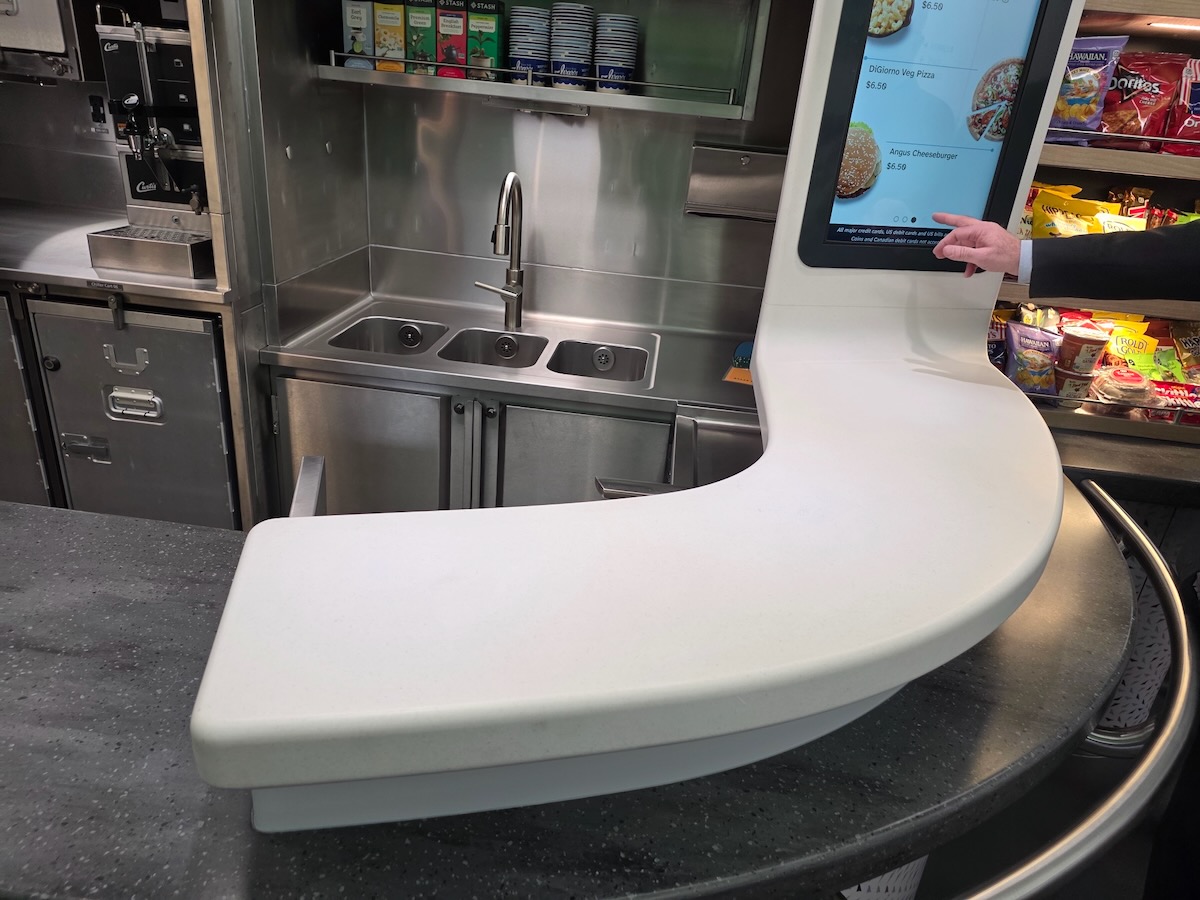
Food
service will be at this counter in the café car. Note the electronic
menu display at the end of the counter, and the grab-and-go food
offerings in the background. Rip Watson
Along with the introductory statement and equipment tour, officials
emphasized the made-in-America theme for the trainsets. They are being
built at Siemens plants in Sacramento, Calif., and Lexington, N.C.
Suppliers in 31 states provide parts.
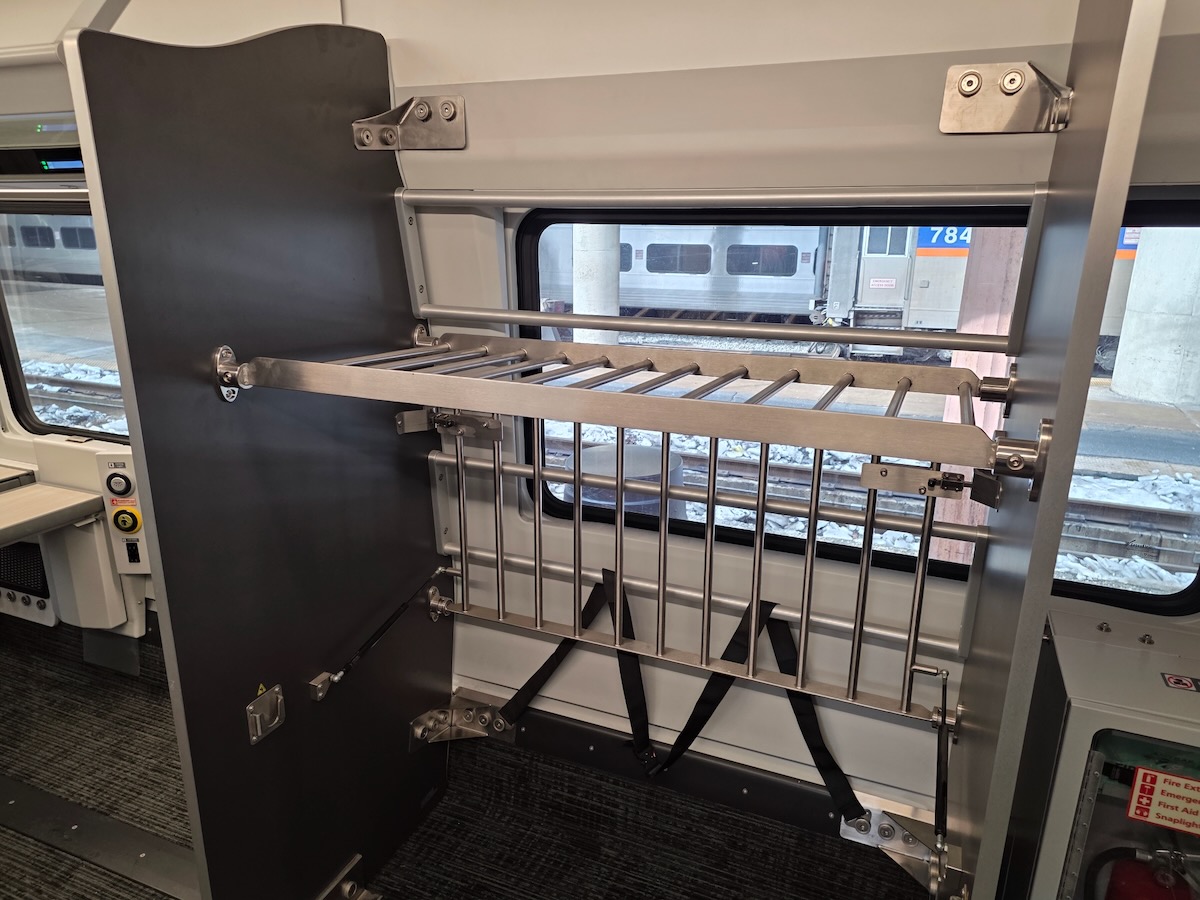
Cars
include baggage racks as well as space above seating areas. Some
trainsets will include compartments for checked baggage. Rip Watson
Details that casual riders might not notice include a small space for
conductors featuring screens for diagnostic information and train
announcements — avoiding the need to have the crew members occupy tables
or seats that passengers could have used. There is a video surveillance
system in each car that activates if the conductor reports an event.
The new equipment is part of a $7.3 billion order, including a
long-term parts and service agreement and related expense, announced in
July 2021 [see “Amtrak, Siemens finalize deal …,”
Trains.com, July 7, 2021]. While the initial sets for the Cascades are
diesel powered, the order also calls for dual-power and battery hybrid
trainsets.
💵 CONTRIBUTE VIA PAYPAL! https://www.paypal.com/cgi-bin/webscr?cmd=_s-xclick&
Witness an eastbound CSX freight, mainly composed of tank cars, glide
from the north to south track at Wellsboro! Watch as it crosses CN's
(Ex-GTW) Battle Creek Sub, powered by a dynamic duo of GE AC4400CW's.
🌞 POWER UP WITH A Solar Charger! https://geni.us/nvGYL
📱➡️📸 TRANSFORM Your Phone Into A Camera! https://geni.us/PhoneCameraConver
📸 📽 Vlogging Kits for Every Creator! https://kit.co/MR77100/vlogging-kits
CSX Tank Train Slides the Crossover at Wellsboro
🚂💥
Eastbound CSX Tank Train Makes North-to-South Crossover at Wellsboro | AC4400CW Power
CSX Tank Train Crossover at Wellsboro | Dual AC4400CWs on the Point
CSX Tank Train Crosses Over at Wellsboro | AC4400CWs Charge the CN Battle Creek Sub
CSX Tank Cars Dominate the Crossing at Wellsboro
Many
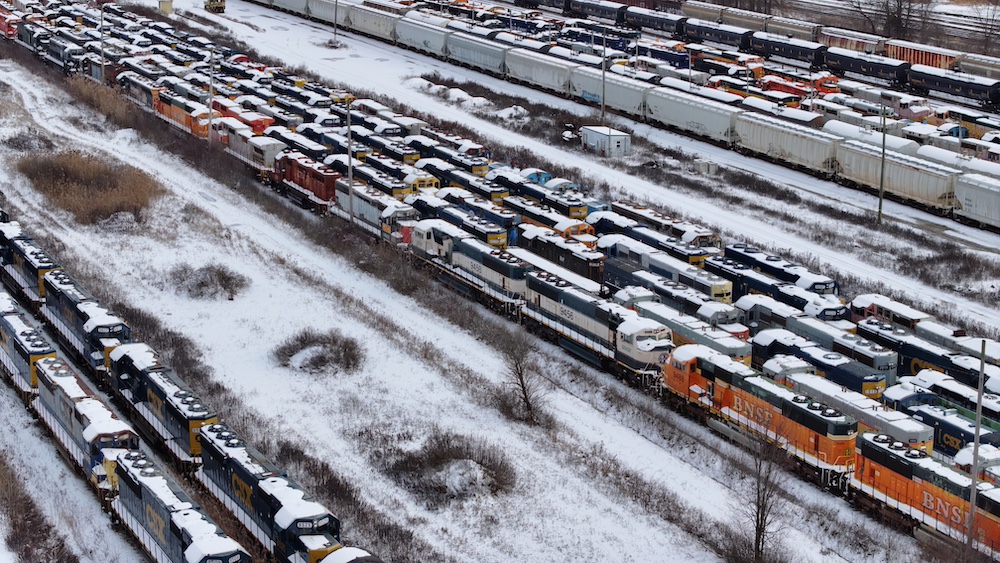
of these stored diesels are destined for scrap. The acres of
locomotives sit idle at LTEX’s Lordstown, Ohio facility on Dec. 23,
2024. The reasons behind these engines’ retirement are varied. Joseph
Zadeh
A frequent question from railfans is why? Why are some diesels destined for scrap?
Why does your favorite locomotive go off the breaker’s yard? Why do some engines get shuffled off this mortal coil while others continue for decade after decade?
There is a multi-part answer to that, and it involves bureaucracy, the economy, mechanical issues, and even plain luck.
CSX
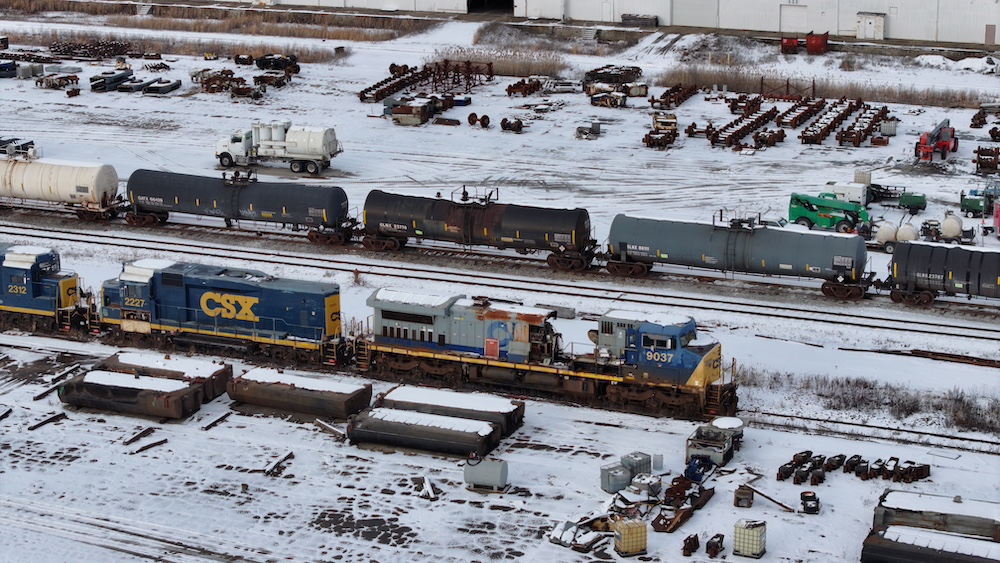
9037 is partially scrapped as LTEX pauses work for the Christmas
holiday in 2024. Its older YN2 paint speaks to a long life without a
rebuild, making it a likely candidate for being sold off. Joseph Zadeh
The economy
The most obvious reason why a locomotive might go to the scrapyard is
simple economics. Prolonged downturns in traffic might render many
locomotives surplus to requirements, or a rise in scrap prices may make
it viable to cut up already-stored locomotives. Due to accounting rules
and best practices, locomotives can remain stored for up to two years
after being pulled from active service before they can be sold for scrap
or other uses. During this time, railroads will often treat these
stored engines as extra power, ready to go at short notice should demand
return or the economy improve.
However, if a locomotive remains in the dead line long enough to be
fully written off the company’s books, it’s put up for sale. Gone are
the days of in-house crews breaking down an engine for the metals —
Conrail was the last of the Class I roads to do that, and the practice
is now left only to short lines and scrap merchants.
Where the engine goes after it leaves the railroad is, once again, a
matter of economy. If the high bidder was a metals dealer, then it will
probably be cut up sooner rather than later. If it goes to an operation
like LTEX, it may be scrapped, it may sit for years waiting a rebuild
and subsequent new life in lease service, or it may wither away to
nothing as a source of spare parts for those engines that continue
operating. An engine can also be sold directly to a short line or an
industrial operation, where its work may continue for decades to come.
NS
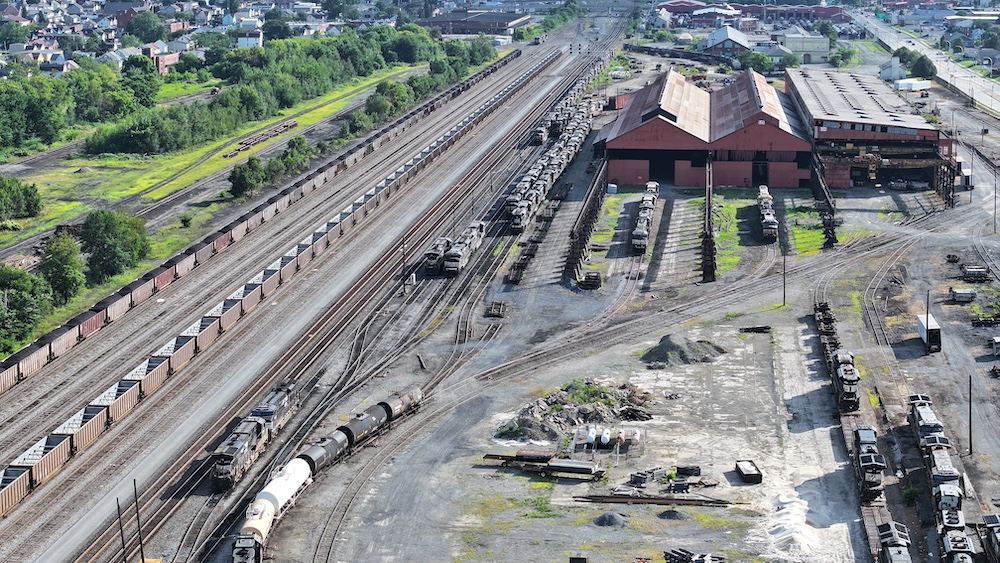
has sizable storage tracks behind Juniata shops in Altoona on Aug. 22,
2023. Some of these locomotives may be repaired, but others will be
eventually sold off to scrap dealers and short lines. In previous years,
Conrail broke up locomotives on this site. Joseph Zadeh
Mechanical problems
As a railway’s fleet of locomotives ages, certain units will
experience more problems than others. There are a variety of reasons for
this, ranging from accidents, poor maintenance, or even design flaws.
For example, the Electro-Motive Division Dash-2 series of locomotives
have significantly fewer wiring issues than their older compatriots due
to Dash-2’s modular circuitry and Exane wiring,
which is more resilient than the wiring formerly used by EMD. As a
result, while the wiring in an SD40 locomotive can decay as the
locomotive nears 30 years old, the wiring in an SD40-2 of similar age
may be in better condition, or at the very least be significantly easier
to re-wire. It seems simple, but these factors can often be the
difference between a long career as a locomotive, or a career change
into razor blades. Similar issues have befallen the General Electric
Dash 8 locomotives; they are significantly harder to rebuild/rewire than
their Dash 9 successors and are more likely to be removed from mainline
fleets as they age.
Additionally, as locomotives get older and their value to the
railroad decreases, major mechanical failures can sideline them
permanently. While some failures are obvious — like a cracked engine
block or major wreck damage — sometimes the final nail in the coffin can
be quite small: In July 2023, the Portland & Western Railroad retired the last SD7 in revenue service – No. 1501 — after it developed a simple water leak.
In
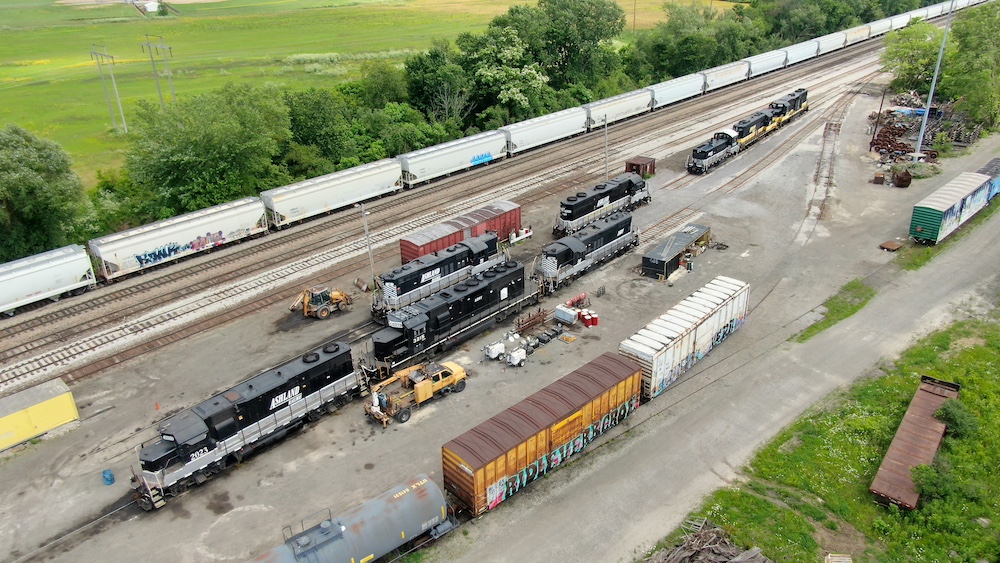
some cases, a locomotive may continue on after it is sold off. NS
SD40-2 No. 3215 was sold to Progress Rail in 2021. Progress Rail acted
as a locomotive broker, and later sold the engine to the Ashland
Railway, an Ohio-based shortline, along with another ex-NS SD40-2. As
seen from the ASRY yard in Mansfield, the SD40-2 may be surplus to NS’s
requirements, but it constitutes a great leap forward for the Ashland,
which otherwise operates a fleet of aging GP-series locomotives. Joseph
Zadeh
The bureaucracy of railroading
Railroads are, among many other things, a business, and with that
comes many levels of bureaucracy that informs (and occasionally hinders)
operations. As an example, a locomotive is nominally under the
authority of the railroad’s mechanical department, which can decide when
it is overhauled and repaired. In day-to-day operations, however, the
engine is really under the control of the local yard- and trainmasters
who have final say on what work the locomotive does and when.
Additionally, a locomotive is also an asset that exists on the
railroad’s balance sheet and is subject to the company accountants.
Finally, the railroad’s C-Suite executives have full control over the
entire railroad and can make a unilateral decision to go around all the
aforementioned bureaucracy. And this explanation only covers locomotives
that are owned outright by railroads, and not engines that are leased
from financing companies.
This all affects the likelihood of a specific locomotive ending up on
the scrap heap. Railroads tend to keep frontline power for around 20-30
years, according to Don Graab, former vice president of mechanical
operations at Norfolk Southern. After that point, efforts will be made
by the railroads to pare down the fleet’s older locomotives. However, in
recent years, with the increased focus on short term financial gains,
decision-making began to become more unilateral.
Graab said, “Historically, the mechanical department always played a
role in what units were stored and what units were sold. For a long
time, 12 or 13 years, the interdisciplinary committee that reviewed this
and made recommendations of management twice a year at six-month
intervals. More recently, they just bypassed the mechanical department,
went right to the local trainmasters and said, ‘you know, you got a big
yard out there in Decatur, give us three GP38s, just give us three
numbers and we’ll scrap those.’ And the bad part about this is it’s just
willy-nilly.”
This direct approach to locomotive scrapping goes a long way to
explaining why otherwise functional locomotives end up in the hands of
scrap merchants like LTEX or National Railway Equipment.
Luck
Sometimes, a locomotive survives (or dies) through the simple luck of the draw.
As noted, a railroad’s bureaucracy (and the various ways it can be
side-stepped) will occasionally strike down an engine in its tracks.
Additionally, mechanical damage can abruptly sideline a locomotive that
otherwise could have kept working well into the future. There are
numerous anecdotes of both, but two stand out:
Texas’ Dallas, Garland & Northeastern Railroad had invested heavily into Genset locomotives in the 2010s. These locomotives did not pan out as expected,
and quickly became hated by crews. One locomotive in particular —
RailPower RP20BD No. 143 — was so thoroughly unreliable and disliked
that when it eventually caught fire, a quick-thinking employee is said
to have directed firefighters to point their hoses into the locomotive’s
generator compartment, rendering the engine a total loss in seconds.
A second example of luck playing a role was cited by Don Graab.
“Yeah, well, occasionally there’s been these snafus where this comes to
mind with the Norfolk & Western. They saved one last Fairbanks-Morse
six-axle locomotive to get to a museum and parked it out at Schaffer’s
Crossing, where I used to work, and it sat there for years, and somebody
who didn’t know about this commitment to give it to whatever museum got
wrapped up and said ‘we gotta get rid of some of this crap’ and sold it
off to a scrap dealer. And the museum was like, “what? You promised us
that.”
“Things like that happened,” Graab added, “this was a six-axle, 2,400
hp locomotive. I don’t remember which predecessor road it was from,
Virginian had them and Wabash had them, but they had cut all the others
down into slugs. This one was still there, with the opposed pistons and
everything. [It] sat there for about six or ten years and, all of a
sudden, it disappeared. That’s a shame.”
📺 How to Get More Video Views on Youtube!
🟥GET AMAZING FREE Tools For Your Youtube Channel To Get More Views:
Tubebuddy (For GROWTH on Youtube): https://www.tubebuddy.com/MR77100
Witness the magic as an eastbound CSX empty hopper train emerges from
the golden glow of the late afternoon sun, rattling across the iconic
ex-GTW diamonds at Wellsboro. Powering this adventure: GE ES44DC #5448
and GE C40-8 #7636.

 Amtrak
literature describes Airo
Amtrak
literature describes Airo